
Fundraising campaigns have one of the strongest natural deadline structures in email marketing. Year-end tax deadlines, grant matching windows, campaign close dates — these aren't manufactured urgency, they're real and consequential. A countdown timer makes them impossible to ignore.
Research consistently shows that fundraising campaigns with visible deadlines outperform open-ended asks. When donors can see exactly how much time is left to act, the impulse to give now overtakes the tendency to give later (which often means never).
How it works
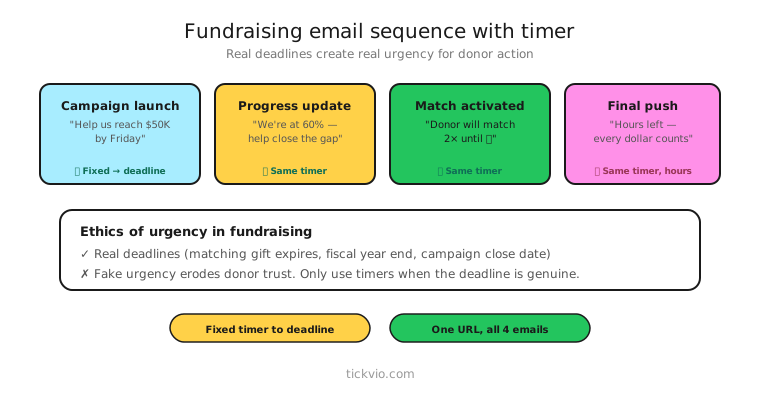
Use a fixed deadline timer for shared campaign deadlines — the matching gift window, the year-end date, the campaign close. Every donor sees the same clock counting toward the same moment, which creates a sense of shared momentum.
For peer-to-peer fundraising or personalised giving windows, use an evergreen timer so each contact gets a personal deadline from when they receive the ask.
The most powerful fundraising timer scenarios
Matching gift windows: A donor's contribution being doubled (or tripled) by a corporate match is already compelling — a ticking clock on that match is even more so. "Every dollar you give before [TIMER] is matched 2-for-1 by [Sponsor]." This is the single most effective fundraising timer use case because the financial incentive is concrete and binary: give now and it's doubled, give later and it's not.
Year-end tax deadline: "Donate before December 31st to receive your tax deduction." The timer counts to midnight on December 31st. The consequence of missing it is financial — donors lose the deduction for the year. Real, credible, urgent.
Campaign close: "Our [Campaign Name] closes in [TIMER]. We're [X]% to our goal — help us cross the finish line." Progress bars paired with countdown timers create powerful combined urgency: time pressure plus social momentum.
Grant deadline campaigns: "We must raise $50,000 to qualify for the [Grant Name] by [TIMER]. Here's where we stand." Grant-conditional campaigns work because the consequence is clear: don't hit the goal before the timer, and the match disappears.
Email sequence
Campaign launch: Introduce the goal, the deadline, and the story. Timer in companion position. Focus on impact, not urgency.
Progress update (midway): Show the goal thermometer. "We're 47% to our goal with [TIMER] remaining. Here's what your donation does." Progress + timer = social proof + urgency.
Matching gift window alert: Dedicated email for the match window if you have one. Timer in hero position. "Your donation is matched until [TIMER]. Give now and double your impact."
Final push (48–72 hours before close): Timer in hero position. Specific gap to goal. "$12,400 to go. [TIMER] left. Every dollar counts."
Last day: Minimal copy, maximum urgency. Timer showing hours. "Today is the last day. [TIMER]"
Campaign close: No timer. Thank donors, share results, set up for the next campaign.
Copy frameworks
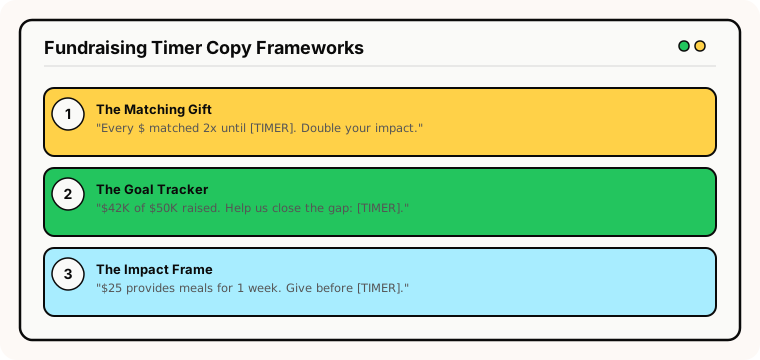
The match frame: "Your $50 becomes $100 before [TIMER]. After that, the match ends."
The gap frame: "We're $8,200 from our goal. You have [TIMER] to make the difference."
The tax frame: "This is your last chance to make a tax-deductible gift this year. [TIMER]"
The impact frame: "Every hour of this campaign, a child receives [benefit]. [TIMER] remaining to be part of it."
Ethics of urgency in fundraising
Urgency is legitimate in fundraising when the deadlines are real — and they almost always are. Tax deadlines, grant windows, and campaign close dates are genuine. The one caution: don't manufacture emergency when there isn't one. Donors who feel manipulated don't give again. When the deadline is real, the timer is honest.
Industry fit
Fundraising timers are essential for nonprofits and charities, political campaigns, educational institutions running alumni drives, religious organisations, and any cause-based organisation with campaign deadlines.
What to measure
Donation rate by email position: Which email in the sequence drives the most donations? Typically the matching gift email and the final-day push.
Average donation size by email: Do timer emails drive larger or smaller gifts than non-timer emails?
Match window conversion rate: What percentage of donors in the match window respond compared to non-match periods?
See our measurement framework for the full approach.
Get started
Create a free fundraising timer — set your campaign or matching window deadline, customise the design, and embed in your donor communications. Works in email and on your campaign landing page. No credit card required.